Voltage drop is a common consideration when designing LED strip lighting installations. When an LED strip is powered from one end, voltage can gradually decrease along the strip, potentially causing the brightness to reduce towards the far end.
Understanding voltage drop helps installers select the right operating voltage, plan suitable strip lengths and achieve more consistent lighting performance.
What Causes Voltage Drop in LED Strip Lights?
LED strips contain conductive copper tracks that carry electrical current along the PCB. As current travels through these tracks, electrical resistance causes a voltage drop.
The effect can become more noticeable over longer continuous runs, particularly when the strip is powered from one end only.
Typical symptoms include:
Brightness gradually decreasing towards the end of the strip
Uneven illumination along a continuous installation
Reduced lighting consistency in longer runs
12V vs 24V COB LED Strips
Choosing between 12V and 24V is an important part of LED strip installation planning.
For the same power consumption, a 24V strip draws approximately half the current of a 12V strip. This can help reduce voltage drop and support longer continuous runs, depending on the strip design and installation conditions.
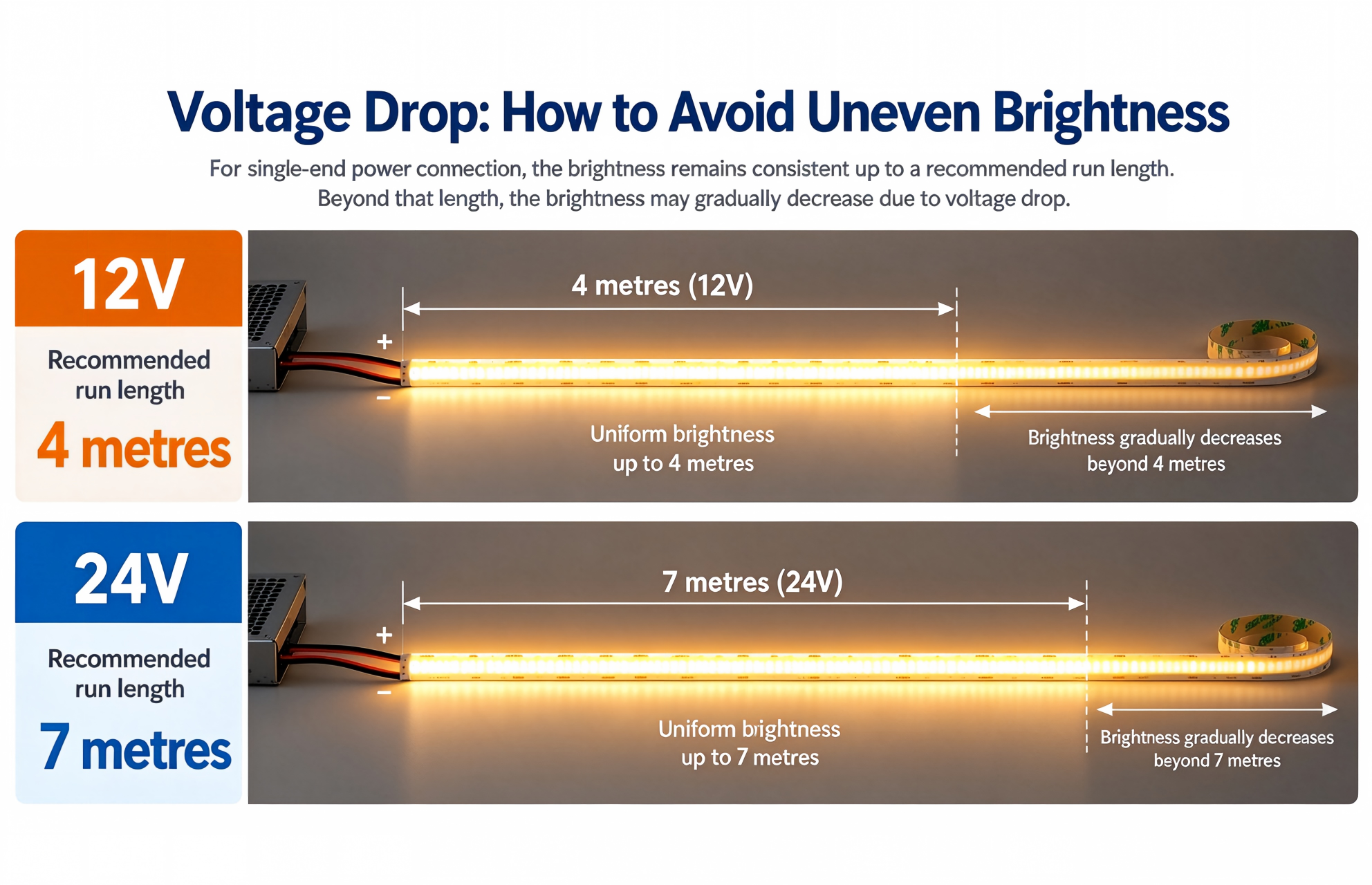
For DV's COB LED strips, the recommended continuous run lengths for single-end power connection are:
|
|
|---|
Operating voltage
| Recommended continuous run
|
12V
| Up to 4 metres
|
24V
| Up to 7 metres
|
These recommendations apply to both our 320 LEDs/m and 480 LEDs/m COB LED strip options.
Within the recommended run length, the strip is designed to maintain consistent brightness under suitable operating conditions. Beyond the recommended length, brightness may gradually decrease due to voltage drop.
How to Minimise Voltage Drop
1. Choose the Appropriate Voltage
Consider 24V COB LED strips for applications requiring longer continuous runs. For shorter runs or systems designed around 12V, a 12V strip may be suitable.
2. Keep Within the Recommended Run Length
For single-end power connection, follow the recommended run length for the selected strip. Avoid assuming that all LED strips can operate over the same distance, as power consumption and PCB design can affect performance.
3. Plan Power Injection for Longer Runs
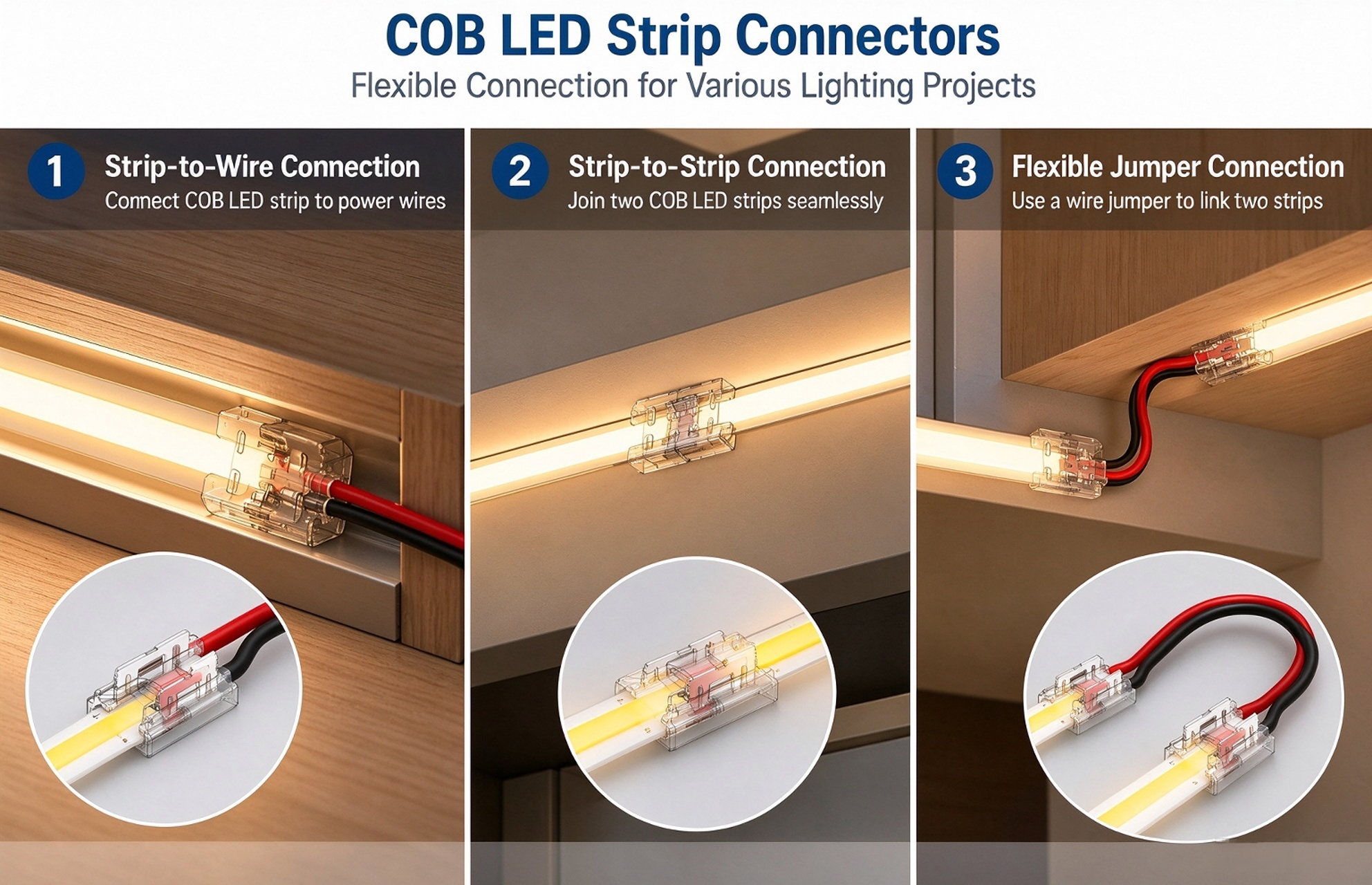
For installations exceeding the recommended continuous run length, consider additional power feed points or feeding the strip from both ends, where appropriate. The final configuration should be designed according to the product specifications and installation requirements.
4. Use Suitable Power Supplies and Wiring
Select a regulated constant-voltage power supply that matches the strip's rated voltage and total power demand. Ensure the connecting cables have an appropriate cross-sectional area and that the installation follows applicable electrical requirements.
DV COB LED Strip Solutions
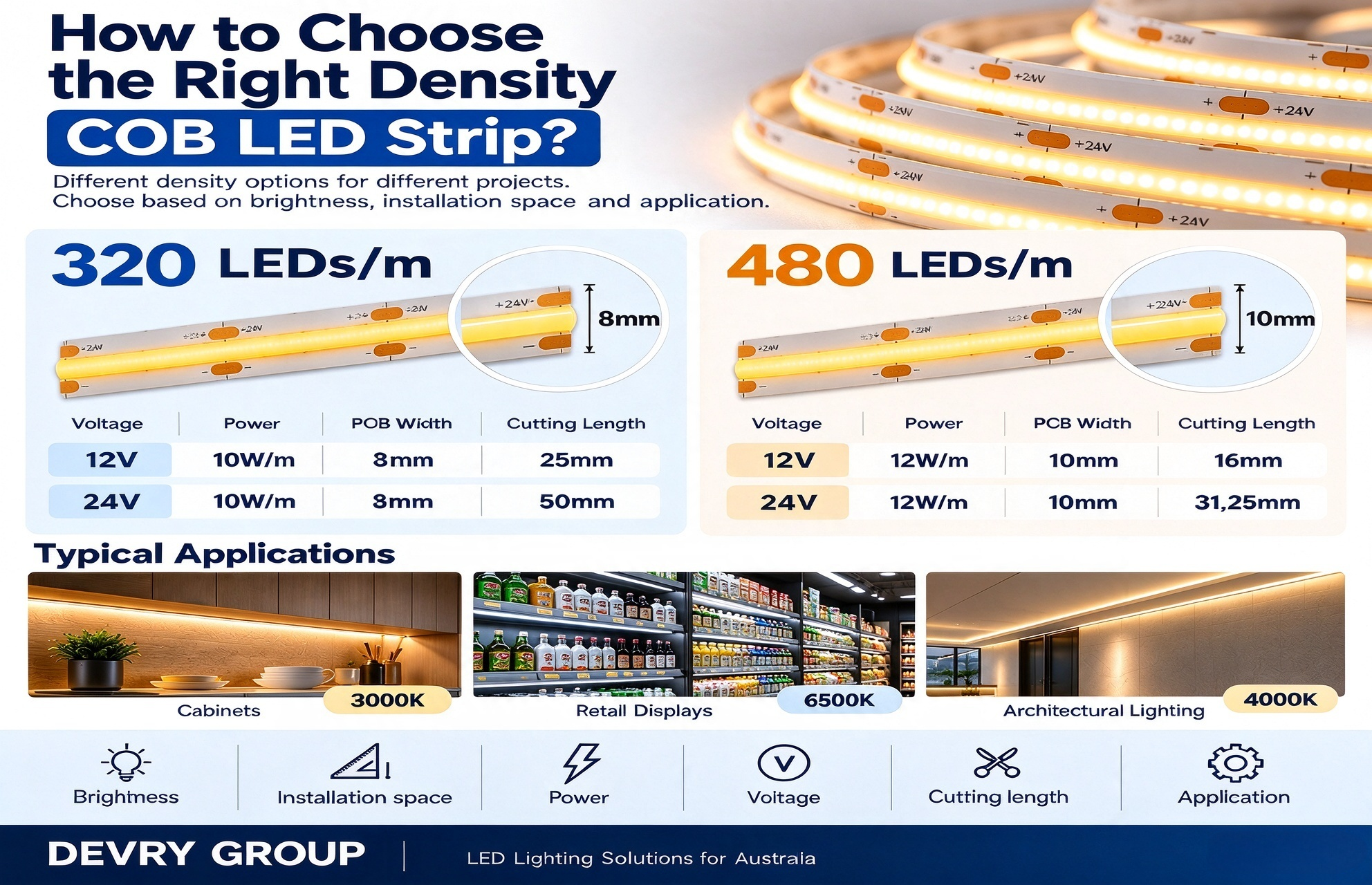
DV supplies COB LED strips in two LED-density options to suit different lighting requirements:
320 LEDs/m COB LED Strip
Power: 10W/m
PCB width: 8mm
Voltage options: 12V / 24V
480 LEDs/m COB LED Strip
Power: 12W/m
PCB width: 10mm
Voltage options: 12V / 24V
Both options are suitable for applications requiring a smooth, continuous line of light, including cabinet lighting, retail displays, shelving and architectural accent lighting.
Need Help Selecting the Right COB LED Strip?
Choosing the correct voltage and planning the power supply layout can help improve brightness consistency and installation reliability.
Contact DV to discuss your COB LED strip requirements and find a suitable solution for your project.
DV LED — COB LED Strip Solutions for Professional Lighting Applications.


 LED Knowledge
Voltage Drop: How to Avoid Uneven Brightness in COB LED Strips



 04 5984 4358


